
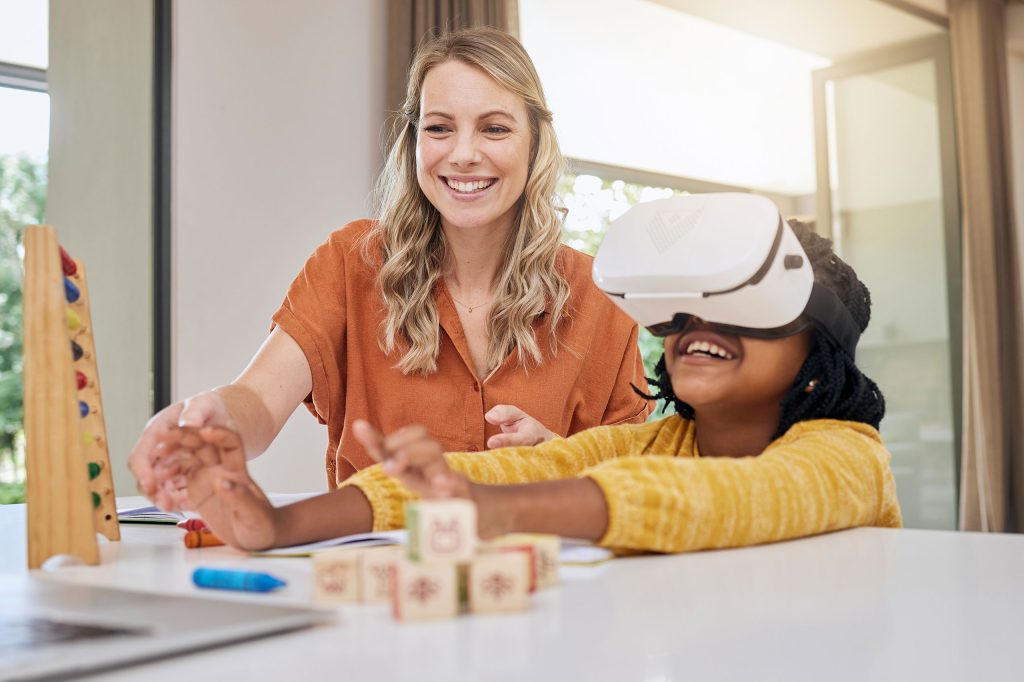
What is Virtual Reality therapy?
Virtual Reality (VR) Therapy for people with disability is an innovative approach that uses immersive virtual environments to support rehabilitation, skill development and mental health. It lets people take part in tailored, controlled and interactive scenarios designed around their needs — a safe space to practise tasks or face challenges at their own pace.
At YesAbility, we are committed to innovative, personalised therapy — and Virtual Reality (VR) Therapy is one of the most exciting methods we offer to support people with disability across Western Australia.
Our VR sessions create immersive, interactive environments that help build physical, cognitive and social skills in a safe, controlled space.
Whether it’s supporting rehabilitation or building confidence for real-world situations, YesAbility’s VR therapy opens new doors — empowering our clients to reach their goals and live more independently.
How VR Therapy can help
- Communication
- Emotional regulation and mindfulness
- Stress and anxiety
- Executive functioning
- Focus and attention
- Cognitive function
- Mobility, reflexes and balance
- Improved coordination
- Pain management
- Motor skills
Who VR Therapy can help
We work with people living with a range of conditions, including:
- Cerebral Palsy
- ADHD
- Autism Spectrum Disorder
- Down Syndrome
- Muscular Dystrophy
- Mental health conditions
- Spina Bifida
- Stroke
- Parkinson’s
- Traumatic Brain Injury
- Global Developmental Delay
- Paediatrics
Why choose YesAbility’s VR Therapy
- Sessions can be billed through your NDIS plan. Ask a practitioner how your plan can support VR therapy, or contact us to find out more.
- The VR headset records and reports data, so you and your practitioner can track progress over time.
- Engaging and effective, VR therapy boosts focus and participation — and makes therapy genuinely enjoyable.
- Easy-to-manage, easy-to-track exercise programs.
- Exercises can be completed at any time, around meals or other daily tasks.
- Tailored, disability-specific rehabilitation designed to help you achieve your NDIS goals.
- Detailed NDIS progress reports.
Our clinic
- Registered clinicians
- Experience working with adults and children with disability
- TGA-registered medical device technology
- Able to support self-managed and plan-managed NDIS participants
Our virtual environments
YesAbility offers a library of more than 190 virtual environments — with total immersion, adjustable parameters, and the ability to repeat scenes as often as needed.
Scientific evidence for VR Therapy
Using virtual reality to train emotional and social skills in children with autism spectrum disorder — PubMed